


GPS Tracker vs Dash Cam: Do You Need Both?
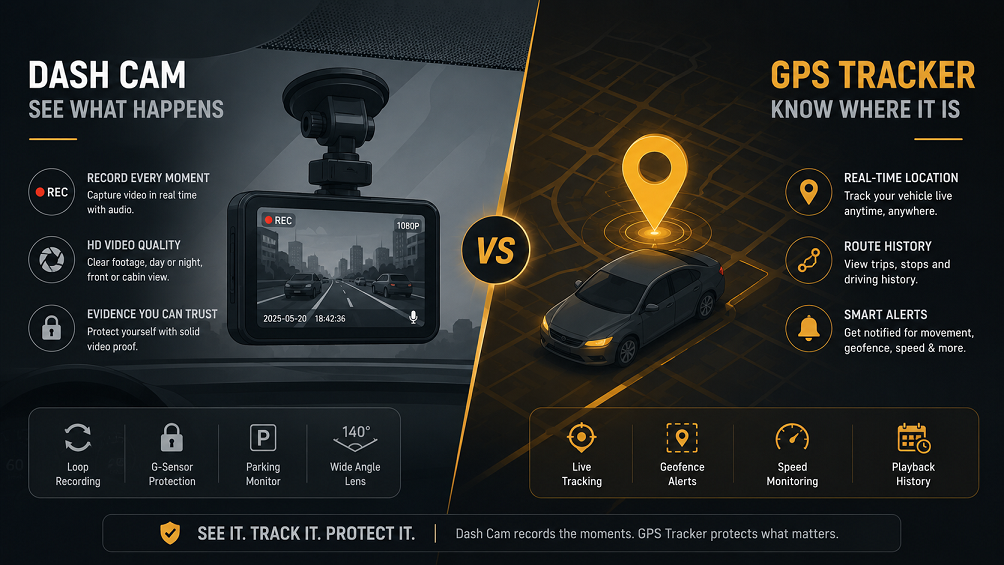
GPS Tracker vs Dash Cam: Do You Need Both?
Two of the most popular vehicle security add-ons solve genuinely different problems. Here's how they compare, and when it makes sense to use both.
GPS trackers and dash cams both fall under "vehicle security," which leads many buyers to assume they're interchangeable or that one makes the other unnecessary. In reality, they capture completely different kinds of information and protect against different risks. Understanding exactly what each one does — and doesn't do — helps you decide whether you need one, the other, or genuinely both.
🎥 How Each Device Actually Works
A dash cam is a continuously recording camera, usually mounted on the windshield, that captures video footage of the road ahead — and sometimes the interior or rear view with additional camera units. Its core purpose is visual evidence: documenting exactly what happened during a collision, a dispute with another driver, or an attempted break-in caught on camera while parked.
A GPS tracker, by contrast, doesn't capture any visual information at all. It reports location data — where the vehicle is, how fast it's moving, and whether it has left a defined area — through a cellular connection to an app. Its core purpose is location awareness: knowing where the vehicle is right now, and being alerted if it moves somewhere unexpected.
📍 GPS Tracker
- Reports real-time location and movement
- Sends geofence and movement alerts
- Supports theft recovery through live tracking
- No visual evidence of what actually happened
- Requires ongoing cellular subscription
🎥 Dash Cam
- Records continuous video footage
- Provides visual evidence for accidents/disputes
- Some models include parking mode motion detection
- No location tracking if the vehicle is actually taken
- Usually a one-time purchase, no subscription
🎯 What Each One Is Actually Good At
📊 Side-by-Side Comparison
| Factor | GPS Tracker | Dash Cam |
|---|---|---|
| Theft Recovery | Strong — real-time location after theft | None — footage doesn't help once the vehicle is gone |
| Accident Evidence | None — no visual record | Strong — captures the actual incident on video |
| Ongoing Cost | Monthly subscription required | Usually one-time purchase only |
| Parking Security | Movement/geofence alerts | Motion-triggered recording on select models |
| Insurance Claim Support | Location and route history | Direct visual proof of fault or incident |
🚗 Which Scenario Fits Which Device?
Frequent Traffic Disputes
A dash cam provides the visual proof needed to resolve fault disputes and support insurance claims after collisions.
Theft-Prone Parking Areas
A GPS tracker gives you the location visibility needed to actually recover a stolen vehicle, which a camera alone cannot provide.
Fleet or Business Vehicles
Both together offer the strongest combination — location accountability plus incident documentation for liability protection.
💰 Cost Comparison Over Time
Dash cams are typically a one-time hardware purchase, sometimes with an optional cloud storage subscription for models offering remote footage access, but many buyers use them entirely offline with a memory card and no recurring cost at all. GPS trackers, on the other hand, almost always require an ongoing cellular subscription to enable the real-time location features that make them useful, since that live connection is what a passive camera simply doesn't need.
Over a multi-year ownership period, this means a dash cam's total cost stays relatively fixed after the initial purchase, while a GPS tracker's total cost continues accumulating through the subscription. This isn't a reason to skip a tracker if security and recovery genuinely matter to you — the ongoing cost is what funds the live connectivity that makes recovery possible — but it's worth factoring into your overall vehicle security budget rather than comparing only the upfront device prices.
🤝 Using Both Together
For vehicle owners genuinely serious about comprehensive protection — particularly fleet operators, rental companies, or owners of high-value vehicles — running both a GPS tracker and a dash cam addresses a wider range of scenarios than either alone. The tracker handles location awareness and theft recovery, while the dash cam handles incident documentation and dispute resolution, and the two rarely conflict or duplicate each other's function in any meaningful way.
For fleet businesses specifically, this combination also strengthens insurance and liability positioning considerably — being able to show both exactly where a vehicle was at a given time and video evidence of what happened during an incident gives a business a much stronger position when disputes or claims arise, compared to having only one type of data available.
❓ Frequently Asked Questions
If I already have a dash cam, do I still need a GPS tracker?
Yes, if theft protection or location awareness matters to you — a dash cam provides no help at all in locating a vehicle once it's been taken, since its footage typically isn't retrievable remotely and certainly won't show you where the car currently is. The two devices serve fundamentally different purposes despite both being vehicle security tools.
Can a dash cam's parking mode replace a GPS tracker's movement alerts?
Not entirely — parking mode motion detection on a dash cam can alert you to activity near the vehicle while parked, but it won't tell you where the vehicle is if it's actually driven away, since the camera itself typically has no independent location-reporting capability once removed from its normal parked position.
Which one should I buy first if I can only afford one right now?
This depends on your specific concern — if theft in your parking area is the bigger worry, prioritize the GPS tracker; if you're more concerned about accident liability and disputes with other drivers, a dash cam addresses that more directly. Many owners eventually add the second device once budget allows, since they genuinely complement rather than duplicate each other.
🔧 Installation and Practical Considerations
Beyond the functional differences, it's worth considering how each device fits into your vehicle practically. Dash cams are almost universally simple to install — typically mounting to the windshield with an adhesive bracket and drawing power from a 12V socket or a hardwired kit — making them accessible for most owners to set up themselves within minutes. GPS trackers, particularly wired units offering the strongest anti-theft features, often benefit from professional installation to ensure proper concealment and electrical connection, adding a modest additional step compared to a dash cam's straightforward setup.
Storage management also differs meaningfully between the two. A dash cam continuously records and typically overwrites older footage on a loop once its memory card fills up, meaning you generally need to actively save specific clips you want to keep before they're overwritten. A GPS tracker's location history, by contrast, is usually stored on the provider's server rather than locally, meaning you don't need to manage storage yourself, though this does mean your historical location data depends on the provider's retention policy rather than a physical memory card you control directly.
✅ Final Thoughts
A GPS tracker and a dash cam aren't competing purchases — they protect against different risks using completely different types of data. If recovering a stolen vehicle matters most to you, the tracker is the clear priority. If documenting accidents and disputes matters more, the dash cam takes precedence. For anyone genuinely serious about comprehensive vehicle protection, particularly fleet and business vehicle owners, using both together closes gaps that either device alone would leave wide open.
📍 Complete Your Vehicle Security Setup
Explore GPS tracker models with real-time alerts and theft recovery support, built to complement any existing dash cam setup.