

GPS Tracker vs Apple AirTag for Your Car
GPS Tracker vs Apple AirTag for Your Car
AirTags are everywhere, but they weren't built for vehicle security. Here's the honest comparison before you rely on one.
Comparing a GPS tracker vs Apple AirTag for car security is one of the most common questions American car owners search for, largely because AirTags are cheap, already familiar, and easy to buy at any Apple Store or major retailer. But AirTags were designed to help you find lost keys and luggage, not to provide the real-time, theft-response tracking a dedicated vehicle GPS tracker offers. Here's exactly where each one fits.
📍 How Each Technology Actually Works
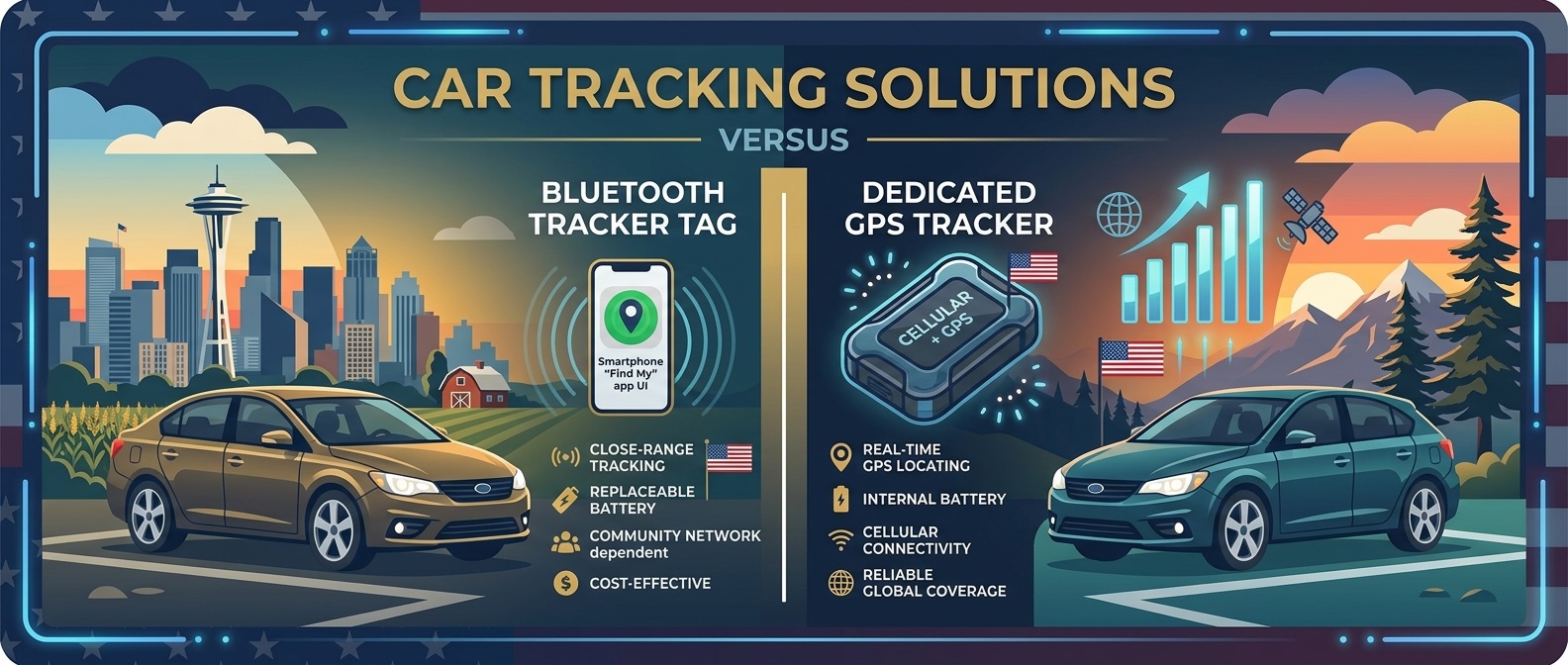
An AirTag doesn't have its own cellular connection or GPS chip in the way a dedicated vehicle tracker does. Instead, it relies on Apple's Find My network — broadcasting a Bluetooth signal that any nearby iPhone can anonymously detect and relay back to you through Apple's servers. This means an AirTag's location accuracy and update frequency depend entirely on how many other Apple devices happen to be nearby at any given moment, which works well in populated areas but can leave real gaps in less-traveled locations.
A dedicated GPS tracker uses actual satellite positioning combined with a cellular connection, reporting location directly and continuously regardless of whether any other devices are nearby. This is a fundamentally more reliable method for something as important as vehicle recovery, since it doesn't depend on the presence of other people's phones to function.
🏷️ Apple AirTag
- Relies on nearby iPhones via Find My network
- No independent GPS or cellular connection
- Low cost, no subscription fee
- Built-in anti-stalking detection alerts
- Location accuracy depends on device density nearby
📡 Dedicated GPS Tracker
- Independent GPS and cellular connection
- Reliable regardless of nearby devices
- Requires ongoing subscription
- Supports geofencing, speed alerts, engine cut-off
- Built specifically for vehicle security and recovery
🎯 Why This Matters for Actual Vehicle Theft
📊 Side-by-Side Comparison
| Factor | Apple AirTag | Dedicated GPS Tracker |
|---|---|---|
| Real-Time Reliability | Depends on nearby iPhone density | Consistent, independent of other devices |
| Ongoing Cost | None beyond initial purchase | Monthly subscription required |
| Theft-Specific Features | None | Geofencing, alerts, engine cut-off |
| Detectability by Thief | Can trigger anti-stalking alerts on their phone | No equivalent detection mechanism |
| Best For | Finding lost items, casual location checks | Genuine theft protection and recovery |
🤔 When an AirTag Might Actually Be Fine
To be fair to AirTags, they're not useless for vehicle-adjacent use — if your main concern is simply "did I forget where I parked at the airport" rather than genuine theft protection, an AirTag tossed in a glovebox does that job perfectly well and cheaply. The distinction that matters is intent: an AirTag is a "find it" tool, while a dedicated tracker is a "protect it" tool, and conflating the two leads to real disappointment if you're relying on an AirTag during an actual theft scenario.
For readers wanting to understand what a proper theft-focused setup actually involves, our GPS tracker buying checklist walks through the ten questions worth asking before choosing a dedicated device.
❓ Frequently Asked Questions
Can a car thief find and remove an AirTag?
Yes, and Apple's own anti-stalking system can work against you here — if a thief has an iPhone, they may receive an alert that an unknown AirTag is traveling with them, prompting them to search for and remove it, defeating the purpose entirely.
Is an AirTag cheaper than a real GPS tracker long-term?
Upfront, yes, since AirTags have no subscription cost. But this comparison misses the point somewhat — the two products solve different problems, and a cheap tool that doesn't reliably solve your actual problem (theft recovery) isn't genuinely cheaper in any meaningful sense.
Does an AirTag work if my car is stolen and driven far away?
It can, but unreliably — location updates depend entirely on the stolen vehicle passing near other iPhone users' devices, which may happen quickly in a city or not at all on a rural route, unlike a dedicated tracker's consistent independent connection.
🔋 Battery and Maintenance Differences
An AirTag runs on a small replaceable coin-cell battery that typically lasts around a year under normal use, requiring no charging routine but eventually needing a simple battery swap. A dedicated GPS tracker's power setup varies by installation type — wired units draw continuous power from the vehicle with no battery maintenance required at all, while battery-powered or plug-and-play trackers need periodic charging, generally on a much shorter cycle than an AirTag's year-long battery life given the more power-intensive job of maintaining active cellular connectivity.
This maintenance difference is worth factoring into a genuinely fair comparison, since a "set it and forget it for a year" AirTag has real convenience appeal precisely because it demands so little upkeep, even though that low-maintenance profile comes at the cost of the reliability gap already covered above.
🏙️ Why Location Density Matters So Much
It's worth explaining the AirTag's core limitation in a bit more detail, since it's the single biggest factor separating the two technologies in practice. Apple's Find My network is essentially crowdsourced — every iPhone running a recent version of iOS quietly and anonymously helps relay AirTag locations back to their owners when in Bluetooth range, without the iPhone user even being aware their device is doing this.
In a dense city with millions of iPhones constantly moving around, this crowdsourced approach works remarkably well, often providing near-real-time updates purely because so many potential relay devices are nearby at any given moment. But drive that same AirTag-equipped vehicle onto a rural highway, into a large empty parking structure, or through an area where iPhone adoption happens to be lower, and the location updates can slow dramatically or stop entirely until the vehicle happens to pass near another iPhone again. A dedicated GPS tracker has no equivalent blind spot, since its cellular connection works anywhere within normal mobile network coverage regardless of how many other specific devices happen to be nearby.
🛡️ The Anti-Stalking Feature Cuts Both Ways
Apple's decision to build anti-stalking protections into AirTags was a genuinely responsible design choice for the product's intended purpose, addressing real concerns about the technology being misused to covertly track people without consent. iPhone users traveling with an unknown AirTag receive an alert, and Android users can use a separate detection app for the same purpose.
The unfortunate side effect for vehicle theft-prevention use is that this same protection can tip off a car thief with an iPhone that a tracker is present, potentially prompting them to search for and remove it before you'd otherwise be alerted to the theft in progress. This isn't a flaw in Apple's design — the anti-stalking feature is doing exactly what it's supposed to do — but it does mean the AirTag's built-in protections work directly against its use as a covert vehicle security device, a tension that simply doesn't exist for dedicated trackers built without this specific privacy-protection mechanism.
✅ Final Thoughts
The GPS tracker vs Apple AirTag question really comes down to what you're actually trying to solve. For casual "where did I park" convenience, an AirTag is fine and inexpensive. For genuine vehicle theft protection — real-time alerts, reliable recovery data, and features like geofencing and engine cut-off — a dedicated GPS tracker is the only option actually built for the job. Choosing based on your real goal, rather than price alone, avoids a nasty surprise the one time it actually matters.
📍 Get Real Vehicle Security
Explore dedicated GPS tracker models built specifically for vehicle theft protection and recovery.