


GPS Tracking for Cargo & Freight: A Logistics Guide for Saudi Arabia
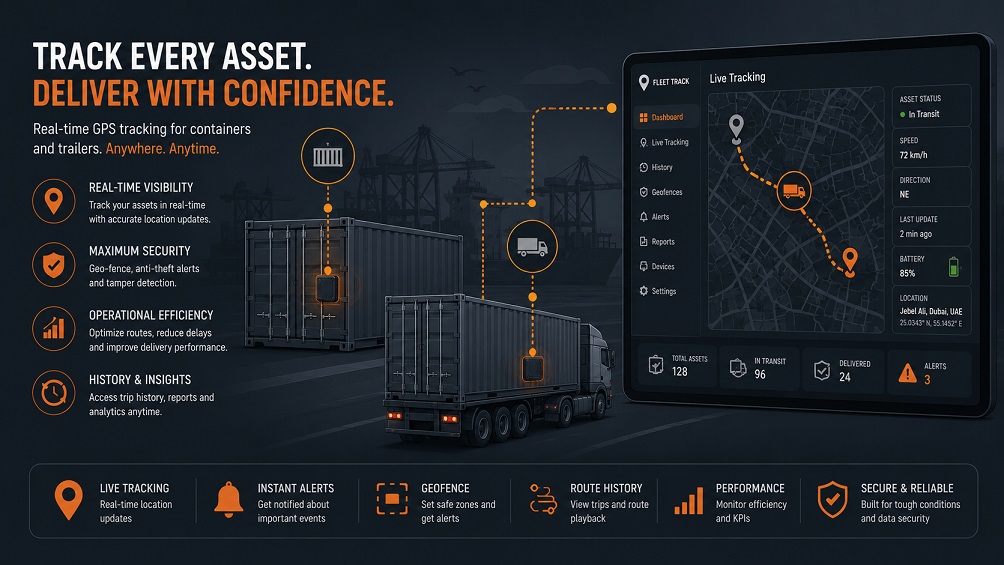
GPS Tracking for Cargo & Freight in Saudi Arabia
As Saudi Arabia's logistics sector expands under Vision 2030, GPS tracking has become core infrastructure for cargo visibility and supply chain accountability.
Saudi Arabia's logistics and freight sector has grown substantially as the Kingdom invests heavily in transport infrastructure and positions itself as a regional logistics hub connecting Asia, Africa, and Europe. For freight and cargo operators, GPS tracking has shifted from a competitive advantage to baseline operational infrastructure — client expectations increasingly assume real-time cargo visibility as standard, not a premium add-on.
📦 Why Cargo Tracking Differs From Vehicle Tracking
Cargo vs Vehicle
Tracking the trailer or container matters as much as tracking the truck, since cargo can be detached and moved independently.
Long Idle Periods
Containers and trailers often sit unused for extended periods between shipments, unlike a daily-driven vehicle.
Condition Monitoring
Temperature-sensitive cargo needs monitoring beyond location alone — a distinct requirement from standard vehicle tracking.
🔑 Core Features for Cargo and Freight Tracking
📊 What Different Cargo Types Need
| Cargo Type | Priority Tracking Feature |
|---|---|
| General Freight/Containers | Long battery life, route deviation alerts |
| Temperature-Sensitive Goods | Integrated temperature/humidity monitoring |
| High-Value Cargo | Real-time alerts, geofencing around approved routes |
| Trailers Between Shipments | Standalone asset tracking independent of towing vehicle |
🛡️ Cargo Theft Prevention
Cargo theft represents a distinct risk pattern from vehicle theft, since it can involve diverting a shipment mid-route, tampering with a container's contents at a stop, or detaching a trailer entirely for later retrieval. Route deviation alerts and geofencing around approved shipping corridors help flag exactly this kind of anomaly early, often before a full theft is complete, giving logistics operators a genuine window to respond rather than only discovering a loss after final delivery fails to occur.
Tamper alerts — notifying if a container door or seal is opened unexpectedly outside a scheduled stop — add another meaningful layer specifically relevant to cargo, addressing a risk pattern that standard vehicle tracking alone doesn't cover.
🛠️ Implementing Cargo Tracking Across a Logistics Operation
🌍 Saudi Arabia's Logistics Growth Context
Saudi Arabia's national logistics strategy has specifically emphasized digital tracking and supply chain visibility as part of broader efforts to position the Kingdom as a regional logistics and transshipment hub. This creates genuine competitive pressure for logistics operators to adopt robust tracking capability, since clients — particularly larger international shippers — increasingly expect real-time visibility as a baseline service standard rather than an optional premium feature when selecting a logistics partner within the Kingdom.
For smaller and mid-sized freight operators specifically, investing in solid cargo tracking capability can function as a genuine differentiator when competing for contracts against larger, more established logistics companies, since demonstrated tracking and accountability capability directly addresses a concern many shippers weigh heavily in vendor selection.
❓ Frequently Asked Questions
Do I need separate trackers for the truck and the trailer?
Generally yes, if genuine end-to-end cargo visibility matters — a truck's tracker only shows the truck's location, which becomes disconnected from the actual cargo the moment a trailer is detached. A dedicated trailer or container tracker maintains visibility regardless of whether it's currently attached to a vehicle.
How long can an asset tracker on a trailer last without charging?
This varies significantly by device and how frequently it's configured to report location, but purpose-built asset trackers designed for infrequent-use equipment can often last months on a single charge, considerably longer than a vehicle tracker designed for daily reporting.
Is temperature monitoring worth the added cost for all cargo types?
Not necessarily — temperature monitoring adds clear, direct value for genuinely temperature-sensitive goods like pharmaceuticals or perishable food, but represents an unnecessary added cost for general freight that has no specific storage condition requirements, so matching this feature to actual cargo type avoids overspending on capability that won't be used.
📑 Integrating Tracking Data Into Client Reporting
Beyond internal operational use, cargo tracking data increasingly plays a direct role in how logistics operators communicate with their clients throughout a shipment's journey. Rather than clients needing to call or email for status updates, many operators now provide direct dashboard access or automated milestone notifications drawn straight from tracking data, giving shippers real-time visibility into exactly where their cargo is at any point without requiring manual status inquiries.
This shift toward client-facing transparency has become a meaningful service differentiator in a competitive logistics market, since shippers managing their own downstream commitments — retail restocking schedules, manufacturing input timing, or contractual delivery windows — benefit considerably from being able to check status independently rather than waiting on manual updates from their logistics provider. Operators who build this capability into their client-facing systems, rather than keeping tracking data purely for internal use, position themselves more competitively against providers still relying on manual status communication.
Setting this up doesn't necessarily require building custom software from scratch — many fleet and cargo tracking platforms include built-in client portal or API capabilities specifically designed for exactly this kind of external data sharing, worth specifically asking about when evaluating tracking providers if client-facing visibility is a priority for your operation.
How does cargo tracking support customs and border documentation?
Documented route and timestamp history from cargo tracking can support customs clearance processes by providing verifiable transit records, particularly relevant for shipments crossing multiple checkpoints or borders within the region's growing cross-border logistics corridors. While tracking data doesn't replace formal customs documentation, it can serve as useful supporting evidence for transit time verification and dispute resolution when questions arise about a shipment's journey.
✅ Final Thoughts
As Saudi Arabia's logistics sector continues expanding, GPS tracking for cargo and freight has moved from a differentiator to baseline operational expectation, particularly for operators competing for contracts with larger international shippers. Matching tracking capability specifically to cargo type — long battery life for infrequent-use trailers, temperature monitoring for sensitive goods, and route deviation alerts for security — provides genuinely useful operational value rather than a one-size-fits-all approach that either overspends or leaves real visibility gaps.
📦 Equip Your Logistics Operation
Explore cargo and trailer-specific GPS tracking solutions built for Saudi Arabia's growing logistics sector.