


Motorcycle GPS Tracker Guide for UAE, Saudi & Qatar
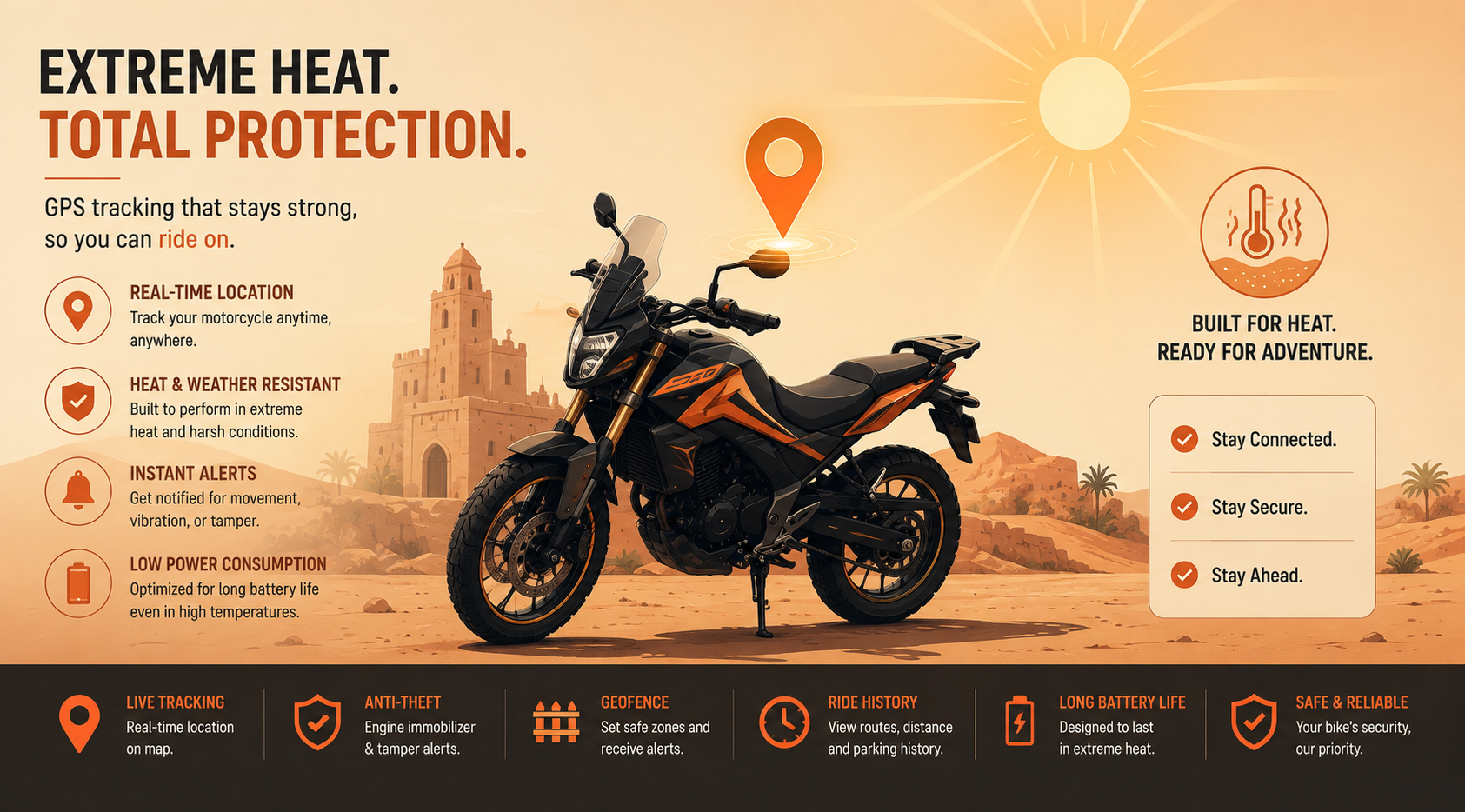
Motorcycle GPS Tracker Guide for UAE, Saudi & Qatar
Extreme heat, fine sand, and dense city traffic all shape what actually works for tracking a motorcycle across the Gulf.
Choosing the right motorcycle GPS tracker for the Gulf means accounting for conditions most trackers simply weren't designed around — sustained summer heat well beyond what automotive electronics are typically rated for, fine desert sand that finds its way into poorly sealed devices, and dense urban traffic across Dubai, Doha, and Riyadh where a bike is parked and exposed dozens of times a week. This guide covers what actually matters for riders across the region specifically.
🌡️ Why Gulf Conditions Demand a Different Tracker
A motorcycle GPS tracker built and tested primarily for milder climates can genuinely underperform once it's sitting on a bike parked in direct summer sun across Qatar, the UAE, or Saudi Arabia for hours at a time. Heat degrades battery cells faster, dust finds its way into loosely sealed housings, and the sheer number of daily parking stops in busy city centers increases the odds a poorly hidden device gets discovered.
📊 Climate Considerations by Use Case
| Use Case | Priority Feature |
|---|---|
| Daily city commuting | Hidden installation, fast movement alerts |
| Weekend desert riding | Dust sealing, offline location logging |
| Delivery/courier work | Continuous power, instant alerts across many daily stops |
| Long-distance touring | Heat-rated battery, extended range connectivity |
🛠️ Setting Up Your Tracker for Gulf Conditions
🏙️ City-by-City Riding Realities
While the underlying climate challenges are similar across the region, daily riding conditions differ enough between major cities that they're worth considering separately when setting up tracking and security habits.
Dubai's dense urban layout means frequent stops at malls, residential compounds, and office buildings, often in shared or public parking with limited direct supervision — exactly the kind of repeated, varied parking pattern where a hidden tracker with fast alerts pays off most. Doha's more compact city center creates a similar pattern on a smaller scale, while Riyadh's rapidly expanding urban sprawl means longer average commuting distances, making battery life and connectivity range genuinely relevant considerations alongside the core heat and dust protection every rider in the region should prioritize.
🔋 Battery Life Under Real Gulf Conditions
Manufacturer battery ratings are typically established under standard test conditions that don't fully reflect sustained exposure to Gulf summer temperatures, where dashboard and body panel temperatures on a parked motorcycle can climb well beyond what a mild-climate rating accounts for. This matters considerably for plug-and-play or battery-only trackers, since heat genuinely accelerates battery degradation over time, sometimes reducing real-world battery life noticeably compared to the manufacturer's stated figures.
For riders relying on a battery-powered device rather than a continuously wired one, building in a more conservative charging routine — topping up more frequently than the rated schedule might suggest — helps avoid the frustrating discovery of a dead tracker exactly when regional heat has quietly shortened its expected runtime. Riders parking primarily in covered or shaded areas will generally see battery performance closer to rated expectations than those regularly parking in direct, prolonged sun exposure.
🧭 Choosing Between Local and International Providers
Riders across the Gulf can choose between trackers from international brands and those from providers with dedicated regional presence, and this choice carries real practical implications beyond the device specifications alone. A provider with local installation support and a regional service center can typically respond faster to setup questions or device issues than an international brand whose support and replacement logistics route through a different region entirely.
This becomes particularly relevant if something does go wrong — a warranty claim or replacement request handled through local support tends to resolve considerably faster than one requiring international shipping and cross-border logistics, which is well worth factoring into the decision alongside the device's technical specifications.
For a deeper look at hiding spots, wired versus battery-powered installation, and what to do if a bike does go missing, our related guide on GPS tracking for desert and off-road riding in the UAE and Saudi Arabia covers the more extreme end of regional conditions in detail.
❓ Frequently Asked Questions
Does a motorcycle GPS tracker really need to be rated differently for the Gulf?
Yes, particularly for sustained heat exposure — a device technically working in a milder climate can still underperform or fail prematurely under consistent Gulf summer conditions if it isn't specifically rated to handle that level of heat over time.
Is dust sealing only relevant for desert or off-road riding?
No — fine dust is a daily reality across much of the region even for city commuting, so a well-sealed device benefits everyday riders, not just those specifically riding off-road or through the desert.
Should I choose a local Gulf-based provider over an international brand?
For most riders, a provider with genuine regional installation and support presence offers a meaningfully better experience than an international brand without local service, particularly if you ever need warranty support or a quick replacement. Weighing this alongside device specifications, rather than focusing on specifications alone, tends to produce a better long-term outcome.
✅ Final Thoughts
A motorcycle GPS tracker for the Gulf needs to handle conditions that milder climates simply don't test for — sustained heat, fine dust, and frequent urban parking stops across UAE, Saudi, and Qatari cities. Prioritizing heat and dust ratings alongside the usual real-time alerts and backup battery features gives riders across the region tracking protection that actually holds up to daily reality, not just a lab-rated spec sheet.
🏍️ Find a Tracker Built for Regional Conditions
Explore heat and dust-rated GPS tracker models designed for motorcycles across the Gulf.