


How Long Does a GPS Tracker Battery Last? Full Guide
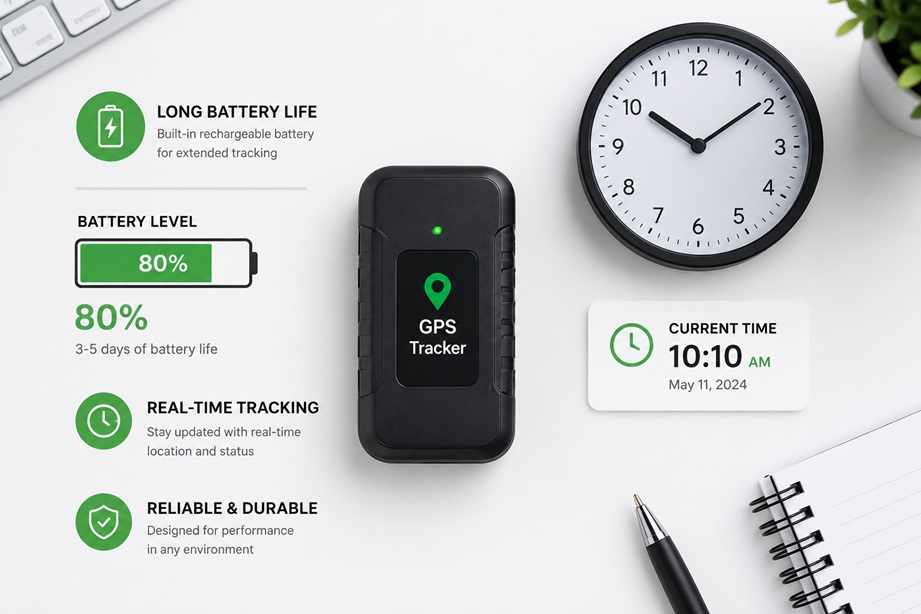
How Long Does a GPS Tracker Battery Last? Full Guide 2026
By MotoTechGPS Editorial Team | Updated: July 2026 | 10 min read
Battery life is one of the most important — and most misunderstood — specs when buying a GPS tracker. Manufacturers often advertise optimistic battery life figures that assume the best-case scenario: low update frequency, perfect temperature, strong signal. Real-world performance can be very different.
This guide gives you the honest, real-world battery life figures for every major tracker type, explains the 5 factors that affect battery duration, and gives you 8 proven tips to make your GPS tracker battery last as long as possible.
GPS Tracker Battery Life at a Glance
Real-Time Mode
3–15 sec updates
1–2 weeksStandard Mode
30–60 sec updates
3–6 weeksLow Power Mode
5 min updates
1–3 monthsMotion-Activated
Sleeps when still
2–6 monthsOBD-II / Hardwired
Powered by vehicle
∞ Unlimited5 Factors That Affect GPS Tracker Battery Life
1. Update Frequency (Biggest Factor)
The faster your tracker sends location updates, the faster the battery drains. A tracker updating every 3 seconds uses roughly 10–15x more power than one updating every 60 seconds. This single setting has more impact than any other factor.
2. Cellular Signal Strength
When the cellular modem can't find a strong signal, it uses dramatically more power searching. A tracker in a low-signal area (rural, underground, metal container) drains its battery 3–4x faster than one with full signal.
3. Temperature
Lithium batteries lose 20–30% capacity in cold weather (below 0°C / 32°F) and degrade faster in extreme heat (above 45°C / 113°F). A tracker mounted under a vehicle in summer or winter will have noticeably shorter battery life than one stored at room temperature.
4. GPS Signal Acquisition
Acquiring a GPS satellite fix from cold start uses significantly more power than maintaining an existing lock. Trackers that power off completely between updates spend more energy on reacquisition than devices that maintain a low-power satellite lock.
5. Sleep Mode Settings
Trackers with motion-activated sleep mode (accelerometer-based wake-up) can extend battery life by 5–20x compared to continuously-on devices. When the asset is stationary, the tracker enters deep sleep drawing only microamps of current.
How Update Frequency Affects Battery Life
| Update Interval | Typical Battery Life | Best Use Case | Rating |
|---|---|---|---|
| Every 3 seconds | 5–10 days | Active theft recovery | Very Short ❌ |
| Every 10 seconds | 7–14 days | Moving vehicle monitoring | Short ❌ |
| Every 30 seconds | 2–3 weeks | Fleet tracking | Moderate ⚡ |
| Every 60 seconds | 3–5 weeks | General vehicle tracking | Good ✅ |
| Every 5 minutes | 6–10 weeks | Asset monitoring | Very Good ✅ |
| Every 30 minutes | 3–5 months | Rarely-moved assets | Excellent ✅ |
| Motion-activated | 2–6 months | Equipment, trailers | Best ✅ |
Real-World Battery Life by Tracker Model
🔵 LandAirSea 54
| Mode | Battery Life |
|---|---|
| 3-sec updates | ~10 days |
| 30-sec updates | ~3 weeks |
| 60-sec updates | ~4 weeks |
| Motion-activated | ~6–8 weeks |
🟢 Optimus 3.0
| Mode | Battery Life |
|---|---|
| 10-sec updates | ~2 weeks |
| 60-sec updates | ~5 weeks |
| 5-min updates | ~10 weeks |
| Motion-activated | ~4–6 months |
🟠 Tracki Pro
| Mode | Battery Life |
|---|---|
| 3-sec updates | ~7 days |
| 60-sec updates | ~3 weeks |
| 5-min updates | ~6 weeks |
| Motion-activated | ~2–3 months |
🔴 Spytec GL300
| Mode | Battery Life |
|---|---|
| 5-sec updates | ~10 days |
| 30-sec updates | ~2.5 weeks |
| 60-sec updates | ~3 weeks |
| Low power mode | ~6 weeks |
Battery Life by Tracker Type
| Tracker Type | Battery Life | Power Source | Best For |
|---|---|---|---|
| OBD-II plug-in No battery | Unlimited ∞ | Vehicle OBD port | Cars, vans, trucks |
| Hardwired No battery | Unlimited ∞ | Vehicle 12V system | All vehicles, bikes |
| Magnetic battery (small) | 1–4 weeks | Built-in Li-ion | Cars, equipment |
| Magnetic battery (large) | 1–6 months | Large Li-ion pack | Equipment, trailers |
| Kids smartwatch GPS | 12–36 hours | Small wearable battery | Children |
| Personal clip-on | 1–5 days | Small Li-ion | People, pets, bags |
| Bluetooth (AirTag) | ~12 months | CR2032 coin cell | Keys, luggage, bags |
| Solar-assisted GPS Emerging | Months to years | Solar + battery | Outdoor assets, livestock |
ℹ️ Important note on Apple AirTag: AirTag uses a CR2032 coin cell battery that lasts approximately 12 months — but it is NOT a real-time GPS tracker. It uses Bluetooth to ping nearby iPhones. Its year-long battery life is impressive but not comparable to cellular GPS trackers, which do far more work.
8 Proven Tips to Extend GPS Tracker Battery Life
1. Enable Motion-Activated Mode
The single most impactful setting. The tracker sleeps when stationary and only wakes on movement detected by the accelerometer. Can extend battery life from weeks to months.
2. Reduce Update Frequency
Switch from 10-second to 60-second updates for non-emergency tracking. This one change can double or triple battery life with minimal impact on usefulness.
3. Keep It at Room Temperature
Store and operate the tracker between 10°C–35°C (50°F–95°F). Avoid mounting in direct sunlight or in engine compartments where heat exceeds 45°C.
4. Ensure Strong Cellular Coverage
Place the tracker where it gets reliable signal — not inside thick metal enclosures. Weak signal forces the cellular modem to constantly retry transmissions, draining power rapidly.
5. Set Up Low-Power Geofence Mode
Some trackers support a mode where they only update frequently when outside a geofence (indicating possible theft), and revert to slow updates when inside a known safe zone.
6. Charge Before Full Depletion
Lithium-ion batteries degrade faster if regularly run to 0%. Charge at 20–30% remaining to prolong the battery's total lifespan over hundreds of charge cycles.
7. Use a Battery Extender Pack
Devices like the Optimus 3.0 support external battery packs that multiply battery life. For long-term asset tracking, a $20–$30 power bank attached to the tracker can extend life by months.
8. Enable Low Battery Alerts
Turn on push notification or SMS low-battery alerts in your tracker's app. Getting warned at 25% charge gives you time to retrieve and recharge before the device goes offline.
What Happens When a GPS Tracker Battery Dies?
When a GPS tracker battery runs out completely, it stops transmitting location data. From your app's perspective, the device simply goes offline. You will no longer receive location updates, geofence alerts, or any notifications from that device.
Most tracking platforms show a "last known location" — the final GPS position before the battery died. This is critical in theft scenarios, as the last known location gives police a starting point for recovery.
⚠️ Theft risk: A dead GPS tracker is a thief's best friend. If your tracker battery dies while a vehicle or asset is out of your sight, you lose all tracking capability. Always enable low-battery alerts and check battery status at least weekly for high-value assets.
Should You Choose Battery or Wired GPS Tracking?
- Choose wired (OBD-II or hardwired) if: Your tracked vehicle has a 12V electrical system, you want zero battery maintenance, and you want always-on tracking with no interruptions. Best for cars, vans, trucks, motorcycles, and boats.
- Choose battery-powered if: You're tracking assets without a power source (trailers, generators, construction equipment, cargo containers), you need a covert hidden tracker, or you want to move the tracker between multiple assets.
- Choose Bluetooth (AirTag/Tile) if: You're tracking low-value personal items like keys, bags, or luggage where true real-time tracking isn't needed and annual battery replacement is acceptable.
Frequently Asked Questions
Final Verdict
For vehicles with an OBD-II port, the battery question is irrelevant — use an OBD tracker like Bouncie and you'll never think about battery again. For assets without a power source, the Optimus 3.0 in motion-activated mode is the longest-lasting battery tracker available in 2026 at up to 6 months per charge.
For most people tracking a car, van, or piece of equipment, the practical answer is: set your update interval to 60 seconds, enable motion-activated mode, and turn on low-battery alerts. Do those three things and your battery-powered tracker will last 4–8 weeks between charges with zero worry.
The worst outcome is a tracker that dies silently just when you need it most. Set your alerts, check weekly, and charge early — that's the only battery strategy you need.
🔋 Need a GPS tracker with long battery life for your vehicle or asset?
MotoTechGPS stocks OBD-II, hardwired, and long-life battery GPS trackers — with motion-activated modes and low battery alerts built in.