


2G Network Shutdown: Is Your GPS Tracker at Risk?
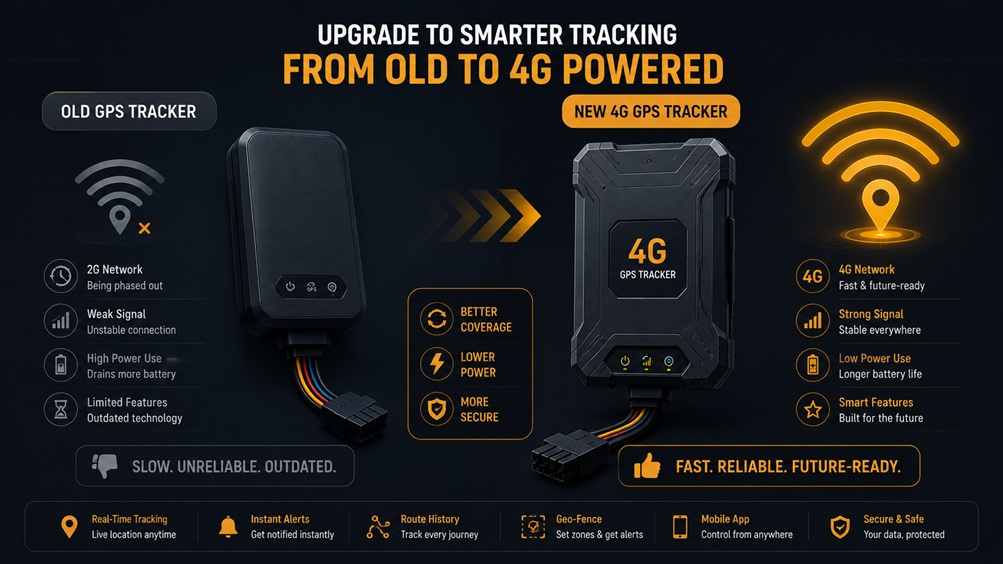
2G Network Shutdown: Is Your GPS Tracker at Risk?
Mobile carriers worldwide are switching off older 2G and 3G networks. If your tracker depends on one, it could quietly stop working with no warning.
Many GPS trackers sold over the past decade were built around 2G cellular technology, since it was cheap, widely available, and more than sufficient for sending small bursts of location data. But as carriers worldwide progressively shut down 2G and 3G networks to free up spectrum for newer technology, trackers relying on these older networks can suddenly stop working entirely — often without any obvious warning to the owner beforehand.
📡 Why Carriers Are Shutting Down 2G and 3G
Mobile carriers have been gradually retiring older network generations for years as part of a broader shift toward more efficient 4G and 5G infrastructure. Older networks consume valuable spectrum that carriers can repurpose for faster, more capable modern networks, and maintaining aging 2G/3G equipment alongside newer infrastructure carries its own ongoing cost that carriers are increasingly unwilling to continue indefinitely.
This shift has already happened in a number of markets and continues progressing in others, meaning the exact timeline varies significantly depending on your specific country and carrier. The practical result for tracker owners is the same everywhere it happens: a 2G-only device simply loses connectivity entirely once the shutdown in that area is complete, regardless of how well the device itself still functions mechanically.
🔍 How to Check If Your Tracker Is at Risk
📊 2G vs 3G vs 4G/LTE-M: What's the Difference for Trackers
| Network Type | Status | Relevance to Trackers |
|---|---|---|
| 2G / GSM | Being phased out in many markets | Older, budget trackers commonly use this — highest risk of disruption |
| 3G | Also being phased out in many markets | Somewhat newer but facing the same long-term retirement trend |
| 4G / LTE | Current mainstream standard | Widely supported and expected to remain viable for years to come |
| LTE-M / NB-IoT | Purpose-built for low-power IoT devices | Increasingly used in newer trackers specifically for long battery life and future-proofing |
🛠️ What to Do If Your Tracker Is at Risk
💡 Why This Matters More for Some Use Cases Than Others
The urgency of upgrading varies depending on how you rely on your tracker. For someone using a tracker mainly for occasional route curiosity, a gradual network shutdown might simply mean noticing the device has stopped reporting at some point, with relatively low stakes attached to the delay in discovering it. For anti-theft protection, fleet management, or family safety monitoring, however, an unexpectedly non-functional tracker represents a genuine security gap — you might believe you have active protection in place when the device has actually been silently non-functional for some time.
This is precisely why proactively checking your device's network compatibility now, rather than waiting to discover the issue only after connectivity is lost, matters most for these higher-stakes use cases. A theft-protection tracker that quietly stopped working weeks or months ago provides a false sense of security that's arguably worse than having no tracker at all, since you might make other security decisions based on the mistaken assumption that tracking protection remains active.
🏢 For Fleet Operators: A Larger-Scale Consideration
Businesses running fleet tracking across many vehicles face a compounded version of this issue, since network shutdown affects every 2G or 3G device in the fleet simultaneously rather than a single personal tracker. Auditing your fleet's tracker network compatibility now, rather than discovering a fleet-wide connectivity gap all at once, allows for a planned, budgeted upgrade cycle rather than an emergency response scrambling to replace dozens or hundreds of devices on short notice.
Many fleet tracking providers offer bulk upgrade programs specifically for this transition, often with more favorable pricing than replacing devices individually, making it worth reaching out proactively to your provider if you're managing tracking across a larger vehicle fleet and haven't already confirmed your current network compatibility status.
❓ Frequently Asked Questions
How do I know if my specific country has already shut down 2G or 3G?
This varies significantly by country and even by individual carrier within the same country, so checking directly with your specific mobile carrier is the most reliable way to get an accurate, current answer for your location rather than relying on general regional assumptions.
Will my tracker just stop working suddenly, or will there be warning signs first?
This depends on how the specific shutdown is implemented by your carrier — some regions see a gradual signal degradation as towers are progressively decommissioned, while others experience a more abrupt cutoff on a specific date. Either way, proactively checking compatibility ahead of time is more reliable than waiting for warning signs that may not always be obvious.
Is upgrading to a 4G tracker significantly more expensive than my current 2G device?
Pricing varies by provider and specific model, but 4G and LTE-M trackers have become increasingly mainstream and competitively priced as the technology has matured, so the price gap compared to older 2G devices has generally narrowed considerably compared to when 4G trackers were newer to the market.
Can I just swap the SIM card in my old tracker to fix the issue?
No — the network compatibility issue is tied to the tracker's internal cellular hardware, not the SIM card itself, so simply inserting a different SIM won't resolve a 2G-only device's inability to connect once that network generation is shut down in your area. The device's modem needs to physically support 4G or LTE-M to work on those networks, which means the tracker hardware itself needs replacing rather than just the SIM.
📦 Trade-In and Upgrade Considerations
Before purchasing a completely new tracker outright, it's worth specifically asking your current provider whether they offer any trade-in credit or loyalty discount for customers upgrading from an affected 2G or 3G device. Providers with a genuine long-term customer relationship often have some flexibility here, particularly if you can demonstrate the upgrade is being driven by a carrier-side network shutdown rather than simple dissatisfaction with the current device, since this framing makes clear the request is about staying with the same provider rather than shopping around entirely.
✅ Final Thoughts
Network technology shifts happen gradually enough that it's easy to overlook until a device simply stops working, but for anything relied upon for genuine security or safety purposes, that's exactly the scenario worth avoiding. Taking a few minutes now to confirm your tracker's network compatibility, and prioritizing 4G or LTE-M for any future purchase, protects against discovering a silent connectivity gap at precisely the moment you'd most need the device to be working.
📡 Upgrade to Future-Proof Tracking
Explore 4G and LTE-M GPS tracker models built for long-term network reliability and stronger connectivity.