


Fleet Management Software Cost: Pricing & ROI Breakdown
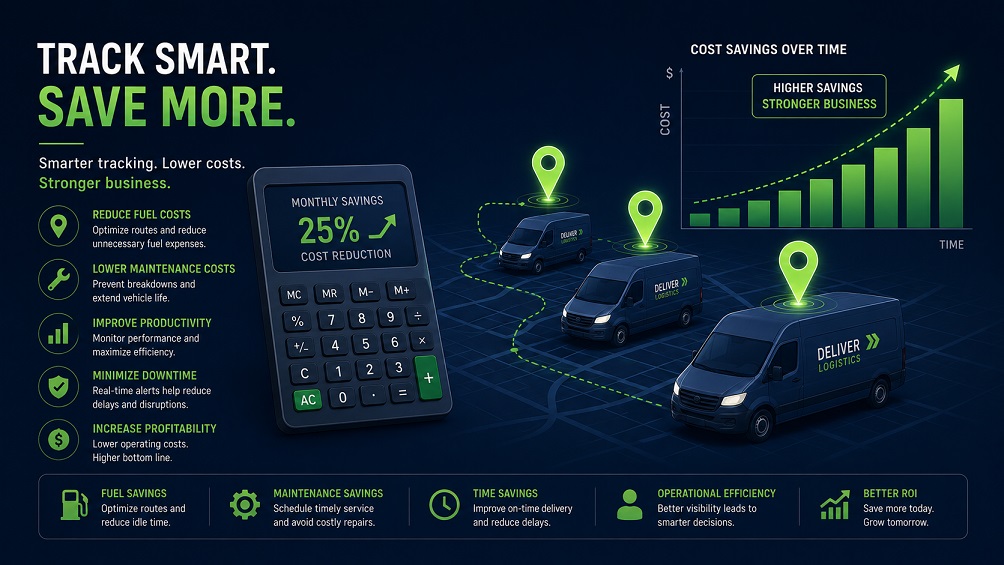
Fleet Management Software Cost: What to Actually Expect
Beyond the per-vehicle sticker price — what drives fleet tracking costs, and how to calculate whether it genuinely pays for itself.
Fleet management software pricing varies widely, and headline per-vehicle prices rarely tell the full story. Hardware, installation, subscription tiers, and add-on features all factor into the real total cost — and just as importantly, into the real return you can expect. This guide breaks down what actually drives fleet tracking costs and how to calculate genuine ROI before committing to a provider.
💰 What Makes Up the Total Cost
Hardware
The physical tracking device per vehicle — a one-time cost, though pricing varies by feature tier.
Installation
Professional installation cost, especially relevant for wired units across a larger fleet.
Subscription
Ongoing per-vehicle monthly or annual fee covering connectivity, dashboard access, and support.
📊 Typical Pricing Tiers
| Tier | Typical Features | Best Suited For |
|---|---|---|
| Basic | Real-time location, basic geofencing, simple reporting | Small fleets, straightforward security needs |
| Mid-Tier | Driver behavior monitoring, route history, fuel tracking | Growing fleets wanting operational efficiency data |
| Enterprise | Multi-user dashboards, API access, custom reporting, dedicated support | Large fleets, logistics operators, multi-site businesses |
📈 Calculating Real ROI
Fleet tracking's return on investment comes from several distinct sources, and a genuinely useful ROI calculation should account for each rather than relying on vague claims like "improves efficiency."
🧮 A Simple ROI Framework
📉 When Fleet Tracking ROI Is Strongest
ROI tends to be most pronounced for fleets with previously limited visibility into routing and fuel use, larger fleet sizes where even small per-vehicle savings compound significantly, and operations with a documented history of unauthorized use or theft concerns. Fleets already running tight, well-optimized operations manually may see a smaller relative improvement, though security and administrative benefits typically still apply regardless of how efficient current operations already are.
Businesses evaluating tracking purely as a security measure, rather than an efficiency tool, should weigh the ROI calculation differently — factoring in the value of reduced theft risk and insurance benefits more heavily than fuel savings alone, since the primary value proposition differs from an efficiency-focused implementation.
❓ Frequently Asked Questions
Do fleet tracking costs typically decrease with larger fleet sizes?
Yes, most providers offer volume-based pricing that improves as fleet size grows, making per-vehicle costs for larger fleets generally lower than the standard per-unit pricing quoted for small fleets or individual vehicles. It's worth specifically negotiating this rather than accepting a flat per-vehicle rate regardless of your total fleet size.
How long does it typically take to see positive ROI?
This varies considerably based on fleet size, current operational inefficiencies, and specific use case, making a universal timeframe difficult to state accurately. Fleets with significant existing inefficiencies or known unauthorized use issues often see faster returns than already well-managed operations, where the improvement margin is naturally smaller.
Should I choose the cheapest provider if my budget is limited?
Not necessarily — the cheapest option per vehicle isn't always the best value once you account for reliability, support quality, and feature completeness, since a lower-quality system that generates unreliable data or requires frequent troubleshooting can undermine the very ROI you're trying to achieve. Comparing total value against total cost, rather than price alone, tends to produce a better long-term decision.
🔍 Hidden Costs Worth Watching For
Beyond the headline hardware, installation, and subscription costs, several less obvious expenses can meaningfully affect the true total cost of a fleet tracking implementation. Understanding these upfront helps avoid budget surprises after you've already committed to a provider.
- Data export or API access fees — some providers charge extra for integrating tracking data with other business systems like accounting or dispatch software, which is worth confirming if system integration matters for your operation.
- Minimum contract terms — annual or multi-year commitments sometimes offer better per-vehicle pricing but reduce flexibility if your fleet size changes significantly during the contract period.
- Add-on sensor costs — fuel sensors, temperature monitoring, or driver ID modules are often priced separately from the base tracker, adding up quickly if multiple add-ons are needed across a larger fleet.
- Training and onboarding time — while not always a direct monetary cost, staff time spent learning a new system represents a genuine, if often overlooked, implementation cost worth factoring into your overall timeline and budget expectations.
🏢 Comparing Provider Pricing Models
Fleet tracking providers structure pricing in a few common ways, and understanding which model a specific vendor uses helps with accurate cost comparison. Per-vehicle monthly subscription is the most common approach, scaling predictably with fleet size. Some providers instead offer tiered flat-rate plans covering a range of vehicles within each tier, which can work out more cost-effective for fleets sitting near the top of a given tier but less efficient for fleets that don't neatly fit the tier boundaries.
A smaller number of providers offer usage-based pricing tied to data volume or reporting frequency rather than a flat per-vehicle rate, which can benefit fleets with lower tracking frequency needs but potentially cost more for fleets requiring frequent real-time updates across many vehicles. Requesting a detailed pricing breakdown under your fleet's actual expected usage pattern, rather than comparing generic list prices, gives a much more accurate basis for comparing providers using different pricing structures.
Is it worth paying for enterprise-tier features if my fleet is still relatively small?
Generally not — enterprise features like API access, custom reporting, and dedicated account management are built for the coordination complexity of larger fleets, and a smaller operation typically won't use enough of that added capability to justify the higher cost. Starting with a tier matched to your current fleet size and upgrading later as genuine need develops is usually the more cost-effective approach than paying for unused capacity upfront.
✅ Final Thoughts
Fleet management software pricing genuinely varies based on hardware, installation, and subscription tier, but the more important question is whether the total cost is justified by real, calculable returns — fuel savings, reduced unauthorized use, faster theft recovery, and administrative time savings. Running through a straightforward ROI calculation specific to your fleet's current situation, rather than relying on generic efficiency claims, gives a far more accurate picture of whether and how quickly the investment pays for itself.
📊 Get a Custom Fleet Pricing Quote
Compare transparent, itemized fleet tracking pricing and calculate your specific ROI before committing.