


GPS Tracking for Electric Vehicle Fleets in the Gulf
GPS Tracking for Electric Vehicle Fleets in the Gulf
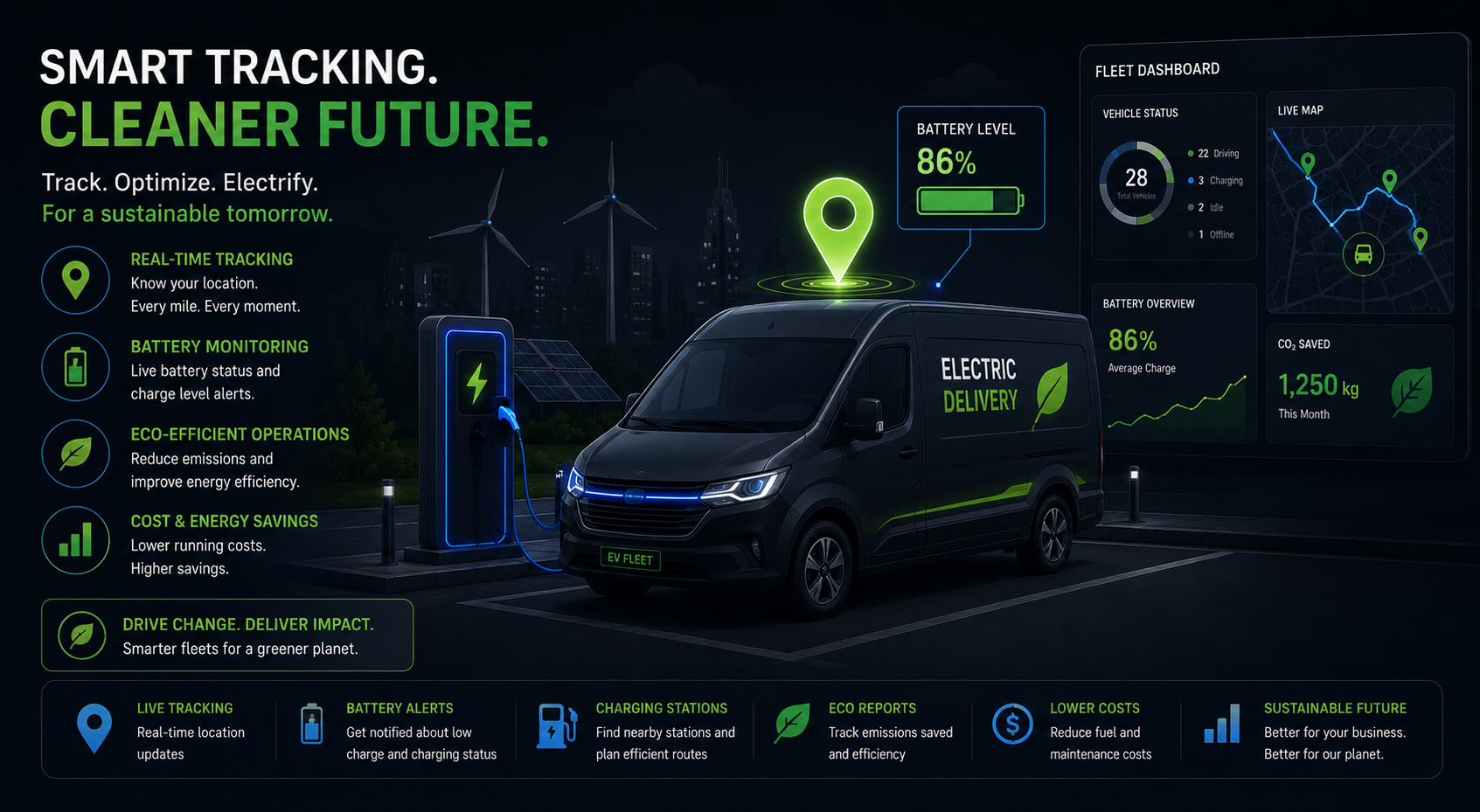
As EV adoption accelerates across the region, fleet tracking needs to account for charge state, range, and charging infrastructure — not just location.
Electric vehicle adoption is accelerating across the Gulf, driven by both government sustainability initiatives and growing commercial fleet interest in lower operating costs. For fleet managers making this transition, GPS tracking needs to evolve alongside the vehicles themselves — an EV fleet has genuinely different operational data needs than a combustion fleet, centered heavily around charge state and range rather than fuel level alone.
🔋 What Changes When Fleets Go Electric
Combustion vehicle fleet tracking traditionally focuses on location, fuel consumption, and maintenance intervals. EV fleet tracking adds an entirely new dimension: battery state of charge, real-time range estimation, and charging session monitoring all become core operational data points that a combustion-focused tracking system simply wasn't built to capture.
📊 EV Fleet Tracking vs Combustion Fleet Tracking
| Factor | Combustion Fleet Tracking | EV Fleet Tracking |
|---|---|---|
| Primary Fuel Metric | Fuel level and consumption rate | Battery state of charge and range |
| Range Planning | Generally not a routing constraint | Active consideration in route planning |
| Refueling/Charging Data | Fuel purchase tracking | Charging session location, duration, cost |
| Climate Impact on Range | Minimal effect on fuel range | Extreme heat can meaningfully reduce EV range |
| Maintenance Data Focus | Engine hours, oil changes | Battery health, charging cycle count |
🛠️ Setting Up Tracking for a Transitioning Fleet
🌡️ Managing Gulf Climate Impact on EV Fleets
Extreme heat affects EV battery performance and range more noticeably than it affects combustion vehicle fuel efficiency, making this a genuinely important consideration for fleet operators across Qatar, the UAE, and Saudi Arabia specifically. Battery cooling systems work harder in extreme heat, sometimes reducing available range compared to manufacturer ratings typically established under more moderate test conditions, and understanding this gap through real tracking data — rather than relying on rated range figures alone — supports more realistic route planning and reduces the risk of a vehicle running low on charge unexpectedly during a route.
Tracking data that specifically captures actual range achieved under real regional operating conditions, compared against manufacturer ratings, gives fleet managers a much more reliable basis for route planning than assuming rated range applies uniformly regardless of climate.
💡 Mixed Fleet Considerations
Many fleets are transitioning gradually rather than switching entirely to EVs overnight, meaning tracking systems often need to manage a mixed fleet of combustion and electric vehicles simultaneously. A tracking platform capable of handling both vehicle types within a single unified dashboard — rather than requiring separate systems for each — considerably simplifies fleet management during this transition period, avoiding the operational friction of dispatchers needing to check two different systems depending on vehicle type.
❓ Frequently Asked Questions
Can a standard GPS tracker work on an EV, or do I need an EV-specific device?
A standard GPS tracker can still provide basic location tracking on an EV, but it won't capture battery charge state, range, or charging session data without integration specifically designed for EV systems. For genuine EV fleet management benefit, choosing a platform with confirmed EV data integration matters considerably more than for basic location-only tracking needs.
Does EV fleet tracking help reduce range anxiety for drivers?
Yes — providing drivers with accurate, real-time range information based on actual current conditions, rather than static manufacturer estimates, helps build confidence in route planning and reduces the uncertainty that often accompanies EV adoption, particularly during a fleet's initial transition period.
How does EV fleet tracking data support charging infrastructure planning?
Reviewing charging session data over time reveals actual usage patterns — which locations see heavy demand, whether current charging capacity is sufficient, and where gaps exist relative to actual route needs — providing a data-driven basis for infrastructure investment decisions rather than guessing at charging network requirements.
📈 The Business Case for EV Fleet Data
Beyond operational convenience, robust EV fleet tracking data increasingly supports genuine business decisions that combustion fleet data never needed to address. Total cost of ownership comparisons between EV and combustion vehicles depend heavily on actual charging costs and patterns, which only detailed tracking data can reveal accurately — theoretical calculations based on assumed charging behavior often diverge meaningfully from what actually happens once vehicles are in daily operation.
This data also matters considerably for companies pursuing sustainability reporting or government incentive programs tied to EV adoption across the region, where documented usage and emissions-reduction data increasingly forms part of compliance or incentive qualification requirements. Fleet operators able to produce clear, tracking-derived reports on EV utilization and associated emissions reductions are generally better positioned to support these reporting needs than those relying on estimates or manual record-keeping.
For fleets evaluating whether to expand their EV segment further, comparing actual tracked operating costs — including charging, maintenance, and any range-related routing inefficiencies — against equivalent combustion vehicle data provides a far more reliable basis for expansion decisions than relying solely on manufacturer specifications or industry-wide averages that may not reflect your fleet's specific regional operating conditions.
Will EV fleet tracking become standard as more Gulf companies adopt electric vehicles?
This seems a reasonable expectation given the direction of both government sustainability initiatives and commercial fleet economics across the region — as EV adoption grows, tracking platforms without genuine EV data capability will likely become an increasingly obvious gap for fleet managers, similar to how basic location-only tracking eventually became insufficient once fleets began expecting driver behavior and fuel data as standard rather than premium features.
✅ Final Thoughts
As EV fleets become more common across the Gulf, tracking systems built specifically to handle charge state, range, and charging infrastructure data — rather than repurposed combustion-vehicle tracking — provide genuinely more useful operational visibility. For fleet managers currently transitioning, confirming EV-specific capability and unified mixed-fleet dashboard support before choosing a tracking provider avoids operational friction during what's often a multi-year transition process.
⚡ Prepare Your Fleet for the EV Transition
Explore GPS tracking solutions built to support both combustion and electric vehicles within a single unified fleet dashboard.