

Real-Time vs Passive GPS Trackers: What’s the Difference?
Real-Time vs Passive GPS Trackers: What's the Difference?
Two fundamentally different ways of tracking a location — here's how each works, what they cost, and which one actually fits what you're trying to do.
Not every GPS tracker shows you a live map with a moving dot. Some devices simply record a detailed history of everywhere they've been, for you to review later — a completely different approach from the real-time tracking most people picture when they hear "GPS tracker." Understanding this distinction upfront can save you from buying a device that doesn't actually match what you need it for.
📡 How Each Approach Actually Works
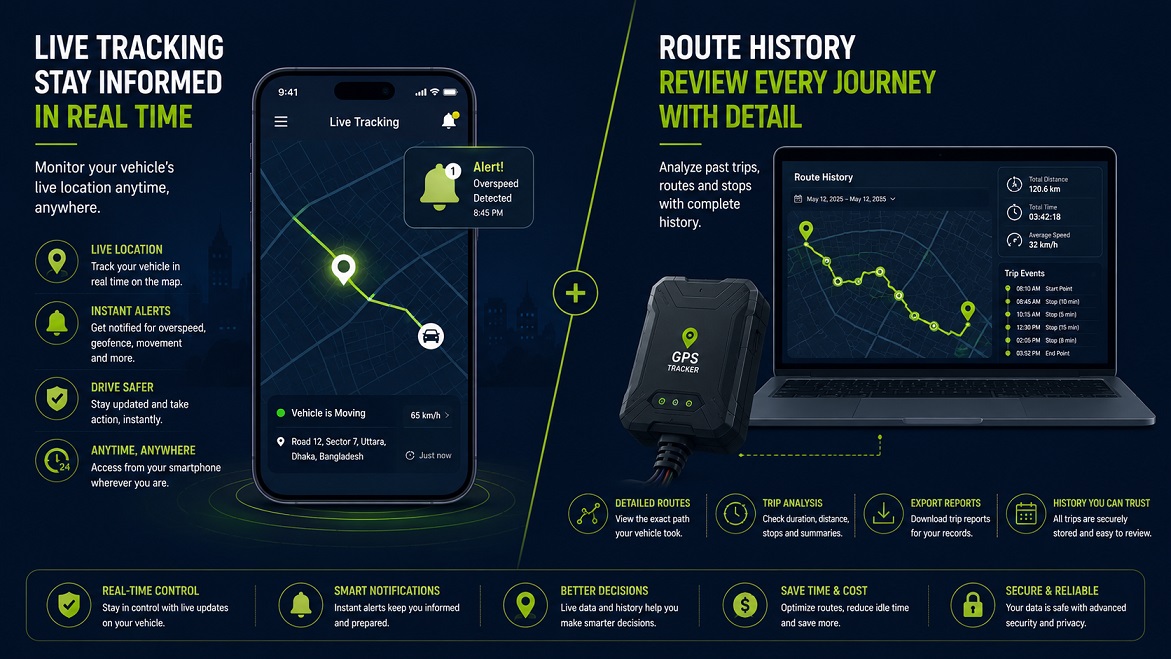
A real-time tracker uses a cellular connection to continuously send its location to a server, letting you see where it is at that exact moment through an app or dashboard — along with instant alerts if it moves unexpectedly or crosses a set boundary. This is the type behind nearly every vehicle security tracker, fleet management system, and family safety device on the market.
A passive tracker, by contrast, doesn't transmit anything live. It quietly logs GPS coordinates at set intervals onto internal storage, and you retrieve that stored history later — typically by plugging the device into a computer or removing a memory card — to see a complete route the device traveled over a period of time. There's no live view, no instant alerts, and critically, no ongoing subscription cost, since there's no cellular connection involved at all.
📶 Real-Time Tracker
- Live location visible through an app at any moment
- Instant alerts for movement, geofence breaches, speed
- Requires ongoing cellular subscription
- Essential for theft response and active safety monitoring
- Higher cost due to continuous connectivity
💾 Passive Tracker
- No live view — data reviewed after the fact
- No instant alerts of any kind
- No subscription cost — one-time purchase only
- Ideal for reviewing routes, mileage, and driving history
- Lower upfront and ongoing cost overall
🎯 Which One Actually Matches Your Goal?
The right choice comes down almost entirely to what you're trying to achieve, since the two types solve genuinely different problems rather than one simply being a cheaper version of the other.
📊 Side-by-Side Comparison
| Factor | Real-Time Tracker | Passive Tracker |
|---|---|---|
| Live Location View | Yes, continuously updated | No — data reviewed after retrieval |
| Alerts & Geofencing | Yes, instant notifications | No real-time alerts |
| Ongoing Cost | Monthly subscription required | One-time purchase, no subscription |
| Best For | Theft protection, safety, fleet security | Route history, mileage audits, curiosity tracking |
| Data Retrieval | Instant, via app anytime | Manual, usually requires physical access to device |
💰 Why the Cost Difference Exists
The price and subscription gap between the two types comes directly from the technology involved. Real-time tracking depends on a continuous cellular connection, which requires an active SIM card and ongoing data costs passed on to you as a monthly or annual subscription. Passive tracking needs none of this — the device simply writes GPS coordinates to internal memory, with no cellular hardware or connectivity costs involved at all, which is why passive trackers are typically cheaper both upfront and especially over time.
This makes the total cost comparison over a year or more quite different from what the upfront price alone suggests. A passive tracker might cost more initially per unit of storage capacity, but with zero ongoing fees, it can work out considerably cheaper over an extended period compared to a real-time tracker's accumulating subscription costs — provided, of course, that passive tracking's lack of live visibility is actually acceptable for your use case.
🔍 Common Use Cases for Each Type
- Real-time: personal vehicle anti-theft protection, family safety monitoring, commercial fleet security, rental car boundary enforcement, delivery rider protection.
- Passive: reviewing a new driver's routes and habits after each trip, auditing company vehicle mileage for tax or expense purposes, research or personal curiosity about travel patterns, budget-conscious buyers who don't need live alerts.
❓ Frequently Asked Questions
Can a passive tracker help recover a stolen vehicle?
Not effectively in the moment, since there's no live location visibility during or immediately after a theft — you'd only see where the vehicle went once you physically retrieve the device's stored data, which typically isn't possible if the vehicle itself is missing. For genuine theft protection, a real-time tracker is the appropriate choice.
Do passive trackers still use GPS satellites the same way?
Yes — the underlying satellite positioning technology is identical between both types. The difference lies entirely in what happens after the location is calculated: a real-time tracker transmits it immediately via cellular connection, while a passive tracker simply stores it locally for later retrieval.
Is it possible to convert a passive tracker into a real-time one later?
Generally no — the hardware differs meaningfully, since real-time trackers include a cellular module and SIM slot that passive devices typically don't have at all. If you think you might need real-time features later, it's usually more practical to choose a real-time-capable device from the start rather than planning to upgrade afterward.
🔄 Hybrid Devices: The Middle Ground
Some trackers on the market blur the line between the two categories, offering a hybrid approach that's worth understanding before assuming you must choose strictly one or the other. These devices typically operate primarily in real-time mode when cellular signal is available, but automatically switch to local storage logging during signal gaps — such as underground parking, remote areas, or basements — then sync that stored data once connectivity returns.
This hybrid approach effectively gives you the best of both worlds for many use cases: live tracking and instant alerts under normal conditions, with a fallback that still captures location history during the inevitable gaps that pure real-time tracking alone would simply miss entirely. The tradeoff is usually a somewhat higher price point compared to a purely passive device, though often still less than premium real-time-only trackers with extensive additional features.
For buyers uncertain about which category fits best, or those whose use case spans both needs — for example, a delivery rider who wants live theft alerts but also values a complete route log for their own working records — a hybrid device is worth specifically asking about when comparing options, since not all sellers highlight this capability prominently even when it's genuinely useful for exactly this kind of split need.
Which type is better for a first-time buyer unsure of their exact needs?
If you're uncertain, a real-time tracker is generally the safer default, since it covers the broader range of use cases — including the security and safety scenarios where passive tracking simply can't help — even though it comes with an ongoing subscription. Passive tracking makes the most sense once you've clearly identified a specific historical-review need where live visibility genuinely isn't necessary.
✅ Final Thoughts
Real-time and passive GPS trackers aren't simply premium and budget versions of the same product — they're built for genuinely different goals. If knowing a location right now and responding quickly to unexpected movement matters, real-time tracking with its ongoing subscription is the only option that actually delivers that. If your interest is reviewing where a vehicle has been afterward, without needing live visibility or alerts, a passive tracker offers a simpler, subscription-free way to get exactly that. Matching the type to your actual goal — rather than choosing based on price alone — is what makes the investment worthwhile either way.
🔍 Not Sure Which Type Fits Your Needs?
Browse both real-time and passive GPS tracker models, and find the right fit for your specific tracking goal.